| |
|
Click on a thumbnail picture below to see the full size version.
|
21 Entries.
|
|
Sunday, January 11
|
View Page
|
 |
BEWARE, THERE'S ICE OUT THERE! Patch-wise, I made good use of the frozen soil and the moderate layer of snow on top: Two days ago I added boron and molybdenum to the patch. HOW and WHY did I do that... Well, B and Mo should be added homogeneously...one should avoid creating spots with excessive B- or Mo-content. In principle, I could add them during fall patch prep, just before roto-tilling the patch. However, B and Mo get leached out rather easily, and I want the water to wash them in (...to the patch) rather than wash them out (into deeper layers of subsoil). Therefore, I took a barrel of water, added the amendments into a good load of water and sprinkled everything more or less homogeneously across the patch using a watering can (16 cans in total). The frozen soil was great for walking across the patch, the first layer of snow was great for further diluting the amendments, and the new snow from the past two days will also help to wash them in (as soon as it melts....probably over the course of the next two weeks, according to the forecast). Wishing you all a great start into a great pumpkin year, stay safe!
|
|
|
Sunday, March 8
|
View Page
|
 |
Today I dug a pit in my patch, not trying to find gold but to see the probably precious soil. About four years ago, I dug over the entire patch two spades deep, turning it upside down, moving the upper half (topsoil) a spade lower and the lower half (the sandy loam) on top, ready for being amended with compost and other good things. Now, about four years later, I was curious to see how things had developed. Good thing #1: As expected, I have found a layer of topsoil that is about two spades deep (50 cm). On the bottom you can see where the sandy loam starts. Good thing #2: The lower half is still pretty dark, even though it has not received any addition of compost over the past five years. Interesting thing #3: The lower half is still darker than the upper half. Apparently, there is a difference between 12 years of patch prep and 4 years of patch prep.
|
|
|
Monday, March 9
|
View Page
|
 |
One thing about spring that I really like: A green pumpkin patch. This year I will wait for another few weeks before patch prep will continue, I love to see that there are less weeds than the years before, so I will let the rye grow some deeper roots in the meantime. Also, soil temperature is still pretty low. Good enough for rye to grow, but not at a reasonable level as it would made any sense to sow another cover crop right now.
|
|
|
Monday, March 9
|
View Page
|
 |
Almost as good as a lush green pumpkin patch: Some first spring flowers :)
|
|
|
Monday, March 9
|
View Page
|
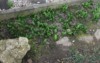 |
Back to the green side of life: The wild garlic, which is growing in a shady corner next to my home, is making me look forward to having the one or the other yummy meal with that great stuff :)
|
|
|
Saturday, March 21
|
View Page
|
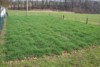 |
Patch today :) In spite of the many frosty nights and the rather cold soil (5 deg. Celsius), the rye keeps growing.
|
|
|
Saturday, March 21
|
View Page
|
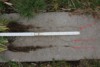 |
Today, I decided to dig another hole in the patch and extract some rye plants, wanted to see how and where their roots are going. Well, I am pretty sure the longest roots fell off the plants just by the weight of the soil attached, but at least some roots were friendly enough to tell me that the plants are digging their way down by more than 1 ft. For the next two weeks, the rye can continue to produce root mass, but then I need to do some next steps...prepare the planting sites and sow another cover crop (mustard) in some places.
|
|
|
Saturday, March 28
|
View Page
|
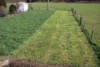 |
Oh well, last week I thought I would let the rye grow for another two weeks, but now we have had such a nice sunny weekend and then a forecast of some rain, which sounds like the perfect time for getting the cover crop sown, and then the rain may give it a good start. Hence, my Saturday started with some mowing, followed by many many hours of further patch prep...
|
|
|
Sunday, March 29
|
View Page
|
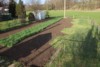 |
...and one day later, the cover crop (mustard) is sown in all the places where you can see the dirt, can-watered for just in case that there will not be as much rain as I am hoping for, and some prep of the planting sites has also begun.
|
|
|
Sunday, March 29
|
View Page
|
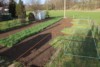 |
So, here is my plan for my 2026 patch layout. This year I want to grow 4 squash plants, and each plant will be contained in one of the four orange rectangles. The mustard-areas inside the rectangles will be free of mustard after beginning of June, so that the squash plants can use that space as well. The other cover crop areas will then grow another cover crop (tagetes, zinnias, and some other stuff). The long rye strip will be rye for another two weeks, and then there will be three rows of potatos. Last but not least, the rye leftovers inside the orange areas will be shaved off (1 - 2 inches thick) and will be piled up inside the blue rectangles. The blue-framed areas will then be covered with clear plastic for some weeks, they will be the planting sites this year.
|
|
|
Monday, March 30
|
View Page
|
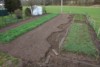 |
Next step accomplished :) (On top of the mounds, I have added some of the rye clippings as well as some alfalfa pellets.) Last step, the addition of a thin soil cover and clear plastic sheets, will be done during the next two weeks, I guess.
|
|
|
Friday, April 3
|
View Page
|
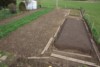 |
Next (half) step finished, just need to do the 2nd mound in a similar manner ;)
|
|
|
Friday, April 3
|
View Page
|
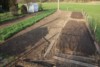 |
...and some hours later: the other part finished as well :)
|
|
|
Saturday, April 4
|
View Page
|
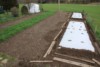 |
Parts of my patch will be working 'under cover' for the next couple of weeks.
|
|
|
Wednesday, April 8
|
View Page
|
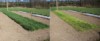 |
In principle, I turn the soil of my patch twice every year (using a spade), and the way I turn the soil depends on the purpose. In fall, just after removing the pumpkin plants and the weeds from the patch, I usually spread compost and other amendments, mix everything into the soil using a roto-tiller, and then I turn the soil by making use of the full depth of my spade (basically turning blocks of soil) before sowing the winter cover crop. In spring, when there is cover crop on top...and perhaps some weeds as well...I want to retain the structure in the deeper soil and I aim at turning the greenery upside down in a rather shallow but efficient manner. For that purpose, I do not turn blocks of soil, I turn shingles of soil, and it all happens the way shown in these five steps. Step 1: I use a mower to remove most of the cover crop.
|
|
|
Wednesday, April 8
|
View Page
|
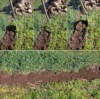 |
Step 2: Somewhere I need to start, and where I start with the procedure I turn the soil in the 'normal manner' turning blocks of soil (a spade deep), but I do it that way along one single row only.
|
|
|
Wednesday, April 8
|
View Page
|
 |
Step 3: For all of the next rows I turn shingles of soil. That means, I insert the spade into the soil at an angle of about 45 deg (shown in the first and second pic of this trio), and the front third of the spade reaches under the already turned row of soil (use your imagination...in the 2nd pic you can 'see' that the spade must reach under the already turned soil). The 3rd pic shows what it looks like when that particular shingle has been turned.
|
|
|
Wednesday, April 8
|
View Page
|
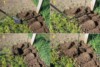 |
Step 4: Basically, this step goes hand in hand with step 3, but here I make it a bit more visible for you. As soon as I take such a 45 deg shingle out of the soil, from below the rim of the previous row, the rim collapses (and thus the greenery of the previous shingle, which is somewhere in this area, falls to a deeper level). For better visualization I have marked a shingle of the previous row with a green stake. So, I insert the spade at an angle of 45 deg (pics 1 and 2), and in pic 3 you can see the spade with the removed shingle as well as the collapsed rim of the previous row. Pic 4 gives you an impression that the 'mound', which results from that turning procedure, consists of the deeper part of the extracted and turned shingle (where there has not been any greenery, it was extracted from the lower soil areas below the previously turned row), and the upper part of the shingle (which contains the greenery) forms the rim of the current row, which will collapse and fall to a deeper level during the procedure of turning the next row of shingles.
|
|
|
Wednesday, April 8
|
View Page
|
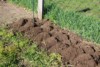 |
Step 5: Well, this is a simple thing...you just need to continue with that procedure row by row, enjoy the nice pattern of shingles of turned soil, occasionally flatten the mounds with a rake (carefully!!! because you don't want to dig out any parts of the previous cover crop) and occasionally have a drink... Cheers!
|
|
|
Tuesday, April 14
|
View Page
|
 |
Today I started the first couple of seeds. This year, my squash line-up will include seeds from 2021-2025, and I want to include one of those classic seeds before they get toooo ooold (...starting all four seeds, hoping for two seedlings...a favorite plant and back-up). Initially, I thought I would start the entire line-up on the same day (and I'm aware that I need to try to be patient with the old seeds for some additional days). However, today I decided to soak the old ones two days prior to starting the rest of the line-up. Reason: I guess, they will need at least 2 (maybe 3) days longer to sprout (if they do sprout at all, if they do it in such a well-behaved way that they can produce a strong seedling that I finally want to transplant into the patch). So, I hope that the entire line-up (we will see if it will eventually include one of today's first starters) will start as a seedling within a narrow time frame of about two days maybe, and then I can monitor their development as a seedling during their first days (prior to hitting patch soil) in direct comprison. Let's see how it works out...
|
|
|
Thursday, April 16
|
View Page
|
 |
Starting more squash seeds today: 905* Bunge 25 (3x), 1083.6* Wagler 22 (6x), 1007.5* Wagler 21 (9x), 300* uow Wagler 21 (8x).
|
|
|
|




 Pumpking - 2026 Grower Diary
